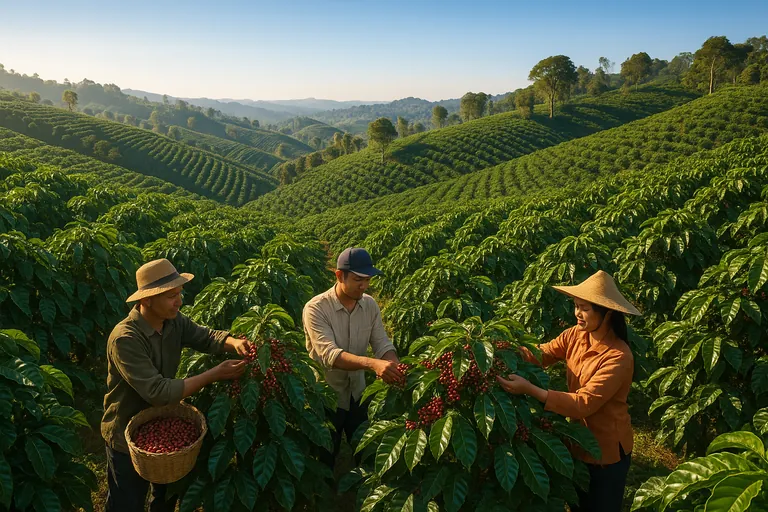
A practical, step-by-step pre‑shipment playbook to build a pesticide residue testing plan for Indonesian green coffee that passes EU and US checks in 2025. Scope, sampling, methods/LOQs, action limits, frequency, and COA formatting—based on what actually works in export operations.
We’ve kept containers moving with zero MRL rejections by using the same residue program we’re sharing here. If you buy, roast, or export Indonesian coffee in 2025, use this as your five‑minute blueprint to design a pesticide testing plan that your EU and US buyers will accept without a fuss.
The 3 pillars of a residue program buyers trust
- Define the analyte scope from farm inputs and destination rules. Don’t test “everything.” Test what’s likely to be present and what’s policed.
- Sample and composite correctly. A perfect lab method can’t rescue a bad sampling plan.
- Use fit‑for‑purpose methods and LOQs, then set internal action limits below MRLs so you can act before a shipment is at risk.
Week 1–2: Map risk and define your testing scope
What’s a practical testing scope for EU‑bound Indonesian green coffee in 2025?
Start with a 250–500 analyte multi‑residue LC‑MS/MS + GC‑MS/MS screen validated to the latest EU SANTE guidance and ISO/IEC 17025. Then bolt on single/targeted methods for gaps that QuEChERS screens don’t cover well.
In our experience, a strong scope for Indonesian arabica and robusta includes:
- Multi‑residue LC‑MS/MS + GC‑MS/MS: organophosphates (e.g., chlorpyrifos—should be ND in EU), carbamates (carbendazim/benomyl metabolites), pyrethroids (cypermethrin, lambda‑cyhalothrin), triazoles (propiconazole, tebuconazole), strobilurins (azoxystrobin), phenylamides (metalaxyl/metalaxyl‑M), neonicotinoids (imidacloprid), and others. Target LOQ: 0.01 mg/kg for most analytes.
- Polar herbicides by dedicated LC‑MS/MS (derivatization/HILIC): glyphosate, AMPA, glufosinate. Typical LOQ: 0.01 mg/kg. Yes, test glyphosate separately. Multi‑res screens rarely include it.
- Bipyridyliums by LC‑MS/MS: paraquat, diquat. LOQ often 0.01–0.02 mg/kg.
- Dithiocarbamates as CS2. LOQ is commonly 0.05 mg/kg; agree acceptance criteria with buyers.
- Consider chlorate/perchlorate if your wet mills use treated water. Many EU buyers now ask for it.
Build the scope from reality on the ground. Audit farm chemical usage by origin and season, then cross‑check against destination market MRLs. For example, smallholder wet‑hulled Sumatras like Sumatra Mandheling Green Coffee Beans may show a different risk profile than fully washed Bali lots such as Arabica Bali Kintamani Grade 1 Green Coffee Beans. When usage is unknown, use the broader scope above until you have clean historical data.
Pro tip: if a buyer provides a “retailer list,” align your scope and LOQs to their private limits. We routinely see private action limits set at 30–50% of the EU MRL.
Week 3–6: Put your sampling plan on rails
How many bags should I sample and how do I composite for a 19–20 ton container?
Here’s what works for a 320–340 bag container of 60 kg bags. It’s aligned with ISO sampling practice for bagged commodities and what EU auditors actually accept.
-
Define the lot. Same origin, processing, and drying period. Don’t composite across different wet mills or weeks.
-
Choose bag count. Sample 10% of bags, minimum 30 bags and maximum 50 bags. For 320 bags, that’s 32–40 bags.
-
Take increments. From each selected bag, draw ~150 g using a coffee sampler/trier from the center third of the bag. Alternate depth and position across pallets/rows to cover the container footprint. Avoid top‑only sampling.
-
Make two independent composites. Combine all increments into two buckets as you go. You’ll end with 2 composites of about 2–3 kg each. One is your primary lab sample, one is your reserve.
-
Sub‑sample and seal. Mix each composite thoroughly, split to 1 kg lab sample + 1 kg duplicate + 500 g retain. Use tamper‑evident seals and sign chain‑of‑custody.
-
Grind at the lab. Let the lab grind to a validated particle size for homogeneity. Don’t pre‑grind on site unless your grinder and cleaning are validated to avoid cross‑contamination.
If you’re shipping multiple product types in one container, create separate composites and COAs per lot. Need help adapting this to your warehouse flow? Contact us on whatsapp and we’ll share a one‑page SOP we use with partner mills.
Week 7–12: Methods, LOQs, turnaround, and buyer‑ready COAs
Are glyphosate and glufosinate included in standard multi‑residue screens?
Usually not. They’re too polar for routine QuEChERS. Order a dedicated LC‑MS/MS method for glyphosate/AMPA and glufosinate, and a separate one for paraquat/diquat.
Which lab methods and LOQs are acceptable to EU/US buyers?
- Accreditation: ISO/IEC 17025 with a scope covering pesticide residues in coffee or in dried plant products.
- Method performance: compliance with the latest EU SANTE analytical quality control guidance.
- LOQs: 0.01 mg/kg for most analytes. Glyphosate/AMPA and glufosinate at 0.01 mg/kg. Dithiocarbamates at 0.05 mg/kg is common, but push for 0.02–0.03 mg/kg if your buyer demands it.
Turnaround and cost in Indonesia today: multi‑residue screens typically 7–12 working days at USD 220–350 per sample. Glyphosate/glufosinate adds USD 60–120. Paraquat/diquat and dithiocarbamates each add USD 50–90. When time is tight, we’ve split composites and run multi‑res + glyphosate first, then add‑ons only if needed.
Trusted options we’ve worked with include ISO‑accredited Indonesian labs and regional hubs in Singapore/Thailand when LOQs or methods are stricter. Always request the lab’s current scope and LOQ table before submitting.
Do I need to re‑test after roasting, or can I apply processing factors?
For pre‑shipment compliance, test green coffee. EU and US checks on import typically refer to the raw commodity. Roasting often reduces many residues 10–70% but some can concentrate on a per‑mass basis because of moisture loss. Glyphosate is relatively stable. If you’re selling roasted coffee into the EU retail channel, either test roasted product or apply conservative processing factors that your buyer accepts in writing. We retest roasted product only when a buyer’s spec demands it.
Action limits, defaults, and US mapping
What action limit should I use if the EU MRL is not set?
The EU default applies: 0.01 mg/kg. Internally, set a tighter action limit so you have room for measurement uncertainty and lot‑to‑lot variability. We recommend 0.005–0.007 mg/kg as your internal trigger for most analytes, and “non‑detect at 0.01 mg/kg” when the lab can’t go lower. For dithiocarbamates, align with your lab’s LOQ and buyer expectation.
Distinguish action limits vs MRLs. The MRL is the legal ceiling. Your action limit is where you start investigating, segregating, or reworking before the shipment is at risk.
How do I map US EPA tolerances to coffee?
The US system is different. Many pesticides have explicit tolerances for “coffee, green bean,” while others have none for coffee. If no tolerance exists, any detectable level can be actionable. Before shipping to the US, map each detected residue to 40 CFR Part 180 tolerances. If a residue isn’t covered for coffee, aim for non‑detect at 0.01 mg/kg and discuss with the buyer’s QA. When in doubt, we harmonize to the stricter of EU default 0.01 mg/kg or the buyer’s private spec.
How often should I test smallholder vs estate supply?
- Aggregated smallholder coffee. Test every export lot. If you have strong GAP training and three consecutive clean COAs per village/mill, you can step down to 1 COA per 10–15 tons with ongoing spot tests. Revert to 100% testing after any exceedance.
- Single‑estate or vertically controlled supply. One COA per 20‑ton container per origin/processing type is typical. Verify farm inputs each season, then test at start/mid/end of harvest to catch drift.
A smart middle ground we use: one full scope at season start per origin, then shorter targeted screens mid‑season focused on likely actives, with a full scope again pre‑peak shipments.
Common mistakes that still cause rejections
- Sampling too few bags or top‑only scoops. Residues are rarely uniform.
- Assuming multi‑res covers glyphosate or paraquat. It doesn’t.
- LOQs above private limits. An LOQ of 0.02 mg/kg is meaningless if your buyer wants 0.01 mg/kg ND.
- Using a generic COA. Missing LOQ, MU, or methods invites follow‑up.
- No action limits. If you only look at MRLs, you’ll act too late when a result sits at 0.009 mg/kg with a ±50% MU.
What a buyer‑ready COA should include
Keep it one page, clean, and comparable:
- Lot ID, origin, process, bag count, net weight.
- Sampling date, sampler, and composite description.
- Lab name, ISO/IEC 17025 number, methods used (SANTE‑compliant), and matrix.
- Full analyte list with Result, LOQ, MRL (EU/US as applicable), and Measurement Uncertainty.
- Statement of compliance to EU MRLs (and to US tolerances if tested).
- Signature and date.
If you need a starting point, we can share a buyer‑vetted template COA and a one‑page sampling SOP. Questions about your project? Contact us on email and we’ll send both.
Quick takeaways you can use today
- Scope: Multi‑res LC‑MS/MS + GC‑MS/MS at 0.01 mg/kg LOQ, plus glyphosate/AMPA, glufosinate, paraquat/diquat, and dithiocarbamates.
- Sampling: 10% of bags, 30–50 bags for a 20‑ton lot, 150 g increments, two composites, sealed duplicates.
- Action limits: 50–70% of MRLs. Use 0.005–0.007 mg/kg when EU default 0.01 mg/kg applies.
- Frequency: Every lot for aggregated smallholders until clean history is built. Estate or controlled supply can step down with proof.
If you want to see the kinds of Indonesian lots we ship under this program, browse our current offers and specs here: View our products.