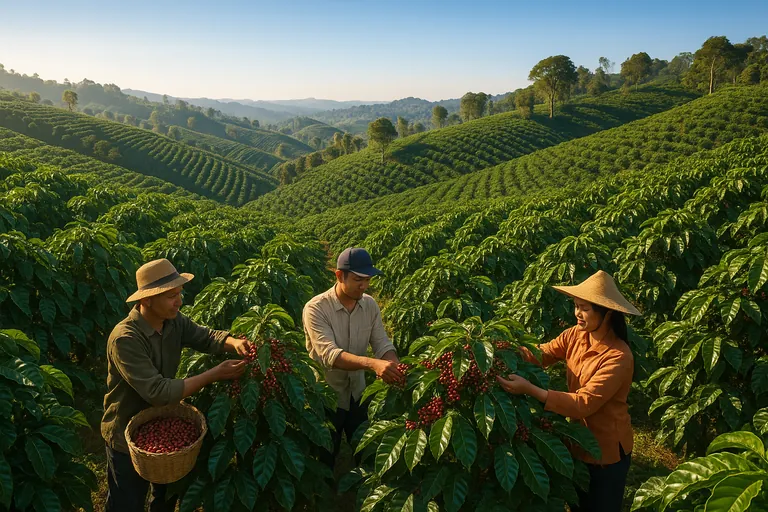
A practical, numbers-first walkthrough to price Indonesian coffee under Rainforest Alliance (RA) vs Fairtrade in 2025. Includes exact formulas, USD/lb to IDR/kg conversions, realistic RA SD ranges, when the Fairtrade minimum applies, farmgate back-calculations, certification cost amortization, and contract clause templates you can copy.
If RA vs Fairtrade pricing has ever stalled your deal, this is the worksheet we use to go from “let us get back to you” to signed in under 48 hours. No fluff. Just the math, the assumptions, and the contract wording that avoids painful back-and-forth.
The 3 pillars of fast pricing alignment
- Know your floors. Fairtrade has a fixed minimum price plus a fixed premium. RA does not have a fixed premium. You negotiate an RA Sustainability Differential (SD) and separately budget Sustainability Investments (SI).
- Convert once, correctly. Most confusion comes from mixing USD/lb with IDR/kg and ignoring moisture and sorting losses. Get your conversion sheet right and half the battle is won.
- Be transparent. Itemize SD, SI, and who receives what. Buyers sign faster and co-ops trust you more.
Step 1 (your Week 1–2 equivalent): Validate market vs floors
Here’s the thing. Your base is either market or a floor.
- Fairtrade: The buyer pays the higher of market or the Fairtrade Minimum Price (FMP), plus the Fairtrade Premium (FP). For Arabica washed, the current FMP is 1.80 USD/lb FOB. The FP is 0.20 USD/lb. Organic differential minimum is commonly 0.40 USD/lb on top. For non-washed Arabica, check the current Fairtrade table; in practice we see 1.60–1.80 USD/lb applied depending on prep.
- RA: No fixed floor or premium. You agree a Sustainability Differential (SD) per lb or per kg and document Sustainability Investments (SI). Both must be clearly reported to the certificate holder.
When does the Fairtrade minimum override NY C? Whenever (NY C + quality differential) is below the FMP. Example: if NY C = 120 c/lb and your Indonesian Arabica differential is +40 c, the market is 160 c/lb. The FMP of 180 applies. You then add the FP of 20 c/lb for a total of 200 c/lb FOB before any organic add-on.
In the last six months, we’ve seen high diffs on Indonesian Arabica due to tight supply and logistics. That means the market often sits above the FMP. But you still need to check, lot by lot.
Practical takeaway: Build a single line in your sheet that calculates Base FOB = max(Market, FMP) and then adds the fixed Fairtrade Premium.
Step 2 (your Week 3–6 equivalent): Price your lot and test the math
USD/lb to IDR/kg conversion
- To get USD/kg from USD/lb, multiply by 2.20462.
- To get IDR/kg, multiply USD/kg by your FX rate.
Example. FMP 1.80 + FP 0.20 = 2.00 USD/lb total Fairtrade FOB uplifted price component. Converted:
- 2.00 × 2.20462 = 4.409 USD/kg
- At 16,000 IDR/USD, that’s 70,544 IDR/kg Use your live FX (we use JISDOR or agreed USD fix on contract date). Don’t hardcode yesterday’s rate in a 3-month shipment.
Realistic RA SD for Indonesian coffee in 2025
In our experience with Indonesian Arabica, negotiated RA SD often lands at:
- Arabica: 0.05–0.12 USD/lb. Sweet spot: 0.06–0.08 for mainstream Grade 1 Sumatra or Java profiles.
- Robusta: 0.01–0.05 USD/lb. Sweet spot: 0.02–0.04 for ELB Robusta. SI budgets vary widely but a practical starting point is 0.01–0.03 USD/lb equivalent, earmarked for training, traceability, or EUDR documentation.
Worked examples you can copy
- Gayo Arabica, RA deal, FOB Jakarta.
- Market base: NY C 190 + diff +45 = 235 c/lb.
- Agreed RA SD: 0.07 USD/lb. SI: 0.02 USD/lb (invoiced as a separate line against the buyer’s investment budget).
- Commercial price: 2.35 + 0.07 = 2.42 USD/lb FOB. SI not counted as price but as an investment line item.
- IDR/kg at 16,000: 2.42 × 2.20462 × 16,000 ≈ 85,220 IDR/kg.
- Mandheling Arabica, Fairtrade deal, FOB Belawan.
- Market base: NY C 120 + diff +40 = 160 c/lb.
- FMP overrides: 180 c/lb. Add FP 20 c. Total: 200 c/lb FOB.
- If Organic applies: add 40 c. Total becomes 240 c/lb.
- Non-organic IDR/kg at 16,000: 2.00 × 2.20462 × 16,000 ≈ 70,544 IDR/kg.
If you’re working on a washed Bali lot comparable to our Arabica Bali Kintamani Grade 1 Green Coffee Beans, those RA SD and Fairtrade figures are the right ballpark for 2025 discussions.
Step 3 (your Week 7–12 equivalent): Back-calc to farmgate and lock the contract
Farmgate payout: a fast, defensible method
From FOB USD/kg, subtract exporter costs and adjust for yield.
- Typical Indonesian Arabica yield chain to Grade 1 green:
- Dry parchment to green outturn: 82–85%
- Sorting loss to Grade 1: 3–6%
- Moisture normalization: 1–2%
- Inland logistics, milling, finance, export ops: 0.20–0.35 USD/lb equivalent (varies by port and season)
Illustration from a 2.42 USD/lb RA deal above:
- Assume total non-farm costs 0.28 USD/lb. Net to parchment pool ≈ 2.14 USD/lb.
- Convert to USD/kg: 2.14 × 2.20462 = 4.72 USD/kg green basis.
- If parchment-to-green yield is 0.83 and sorting/moisture combined loss is 0.05, effective yield ≈ 0.83 × 0.95 = 0.7885.
- Parchment price equivalent: 4.72 × 0.7885 ≈ 3.72 USD/kg parchment.
- In IDR at 16,000: ≈ 59,600 IDR/kg parchment. Reality check with your co-op’s actual yield and loss logs. Small changes in outturn can swing farmer payout by 1,000–2,000 IDR/kg.
How much of the Fairtrade premium reaches farmers?
Fairtrade Premium (0.20 USD/lb) is paid to the producer organization. In Indonesia, we typically see 50–80% of that value returned to members as cash top-ups or inputs, with the balance used for community or productivity projects. The exact split follows the co-op’s General Assembly plan. We advise recording the allocation in the contract annex and progress report.
Budgeting certification and audit costs per metric ton
- RA: CoC audit + admin at exporter 25–45 USD/MT. Producer group audit and internal management 30–60 USD/MT. Combined planning figure: 55–105 USD/MT.
- Fairtrade: Trader license + FLO-Cert audits and producer group compliance typically 40–90 USD/MT combined. Over the past two quarters, EUDR traceability work has added 10–20 USD/MT of documentation overhead for many Indonesian supply chains. We now show it as a separate “traceability admin” line. Buyers appreciate the transparency.
Contract clauses you can paste into your next offer
- RA SD clause: “Buyer agrees to pay a Rainforest Alliance Sustainability Differential of USD 0.07/lb on contracted Net Shipped Weight, itemized on commercial invoice and paid to the RA certificate holder. Sustainability Investments of USD 0.02/lb will be invoiced separately against approved activities. Both SD and SI will be reported per RA requirements.”
- Fairtrade clause when market > FMP: “Price shall be NY C + differential at time of fixation. Fairtrade Premium of USD 0.20/lb is additional and itemized. If NY C + differential falls below the Fairtrade Minimum Price applicable to the product (washed Arabica), the Fairtrade Minimum Price shall apply. Organic differential, if applicable, is USD 0.40/lb.”
- FX conversion clause for IDR contracts: “If price is expressed in IDR/kg, conversion from USD shall use the Bank Indonesia JISDOR rate on Bill of Lading date unless otherwise mutually agreed in writing.”
- Outturn clause: “Farmgate pricing is based on an assumed parchment-to-green outturn of 83% and sorting loss of 4%. Deviations >2% will trigger a joint review and adjustment per agreed formula.”
Practical takeaway: Clear SD/FP lines and a named FX source reduce 80% of disputes we see.
The 5 mistakes that kill RA vs Fairtrade deals
- Mixing SD and SI. SD is a price differential. SI is a budgeted investment. Don’t lump them.
- Forgetting moisture/sorting losses. You’ll overpromise farmgate by 1,000–2,500 IDR/kg.
- Using stale FX. At minimum, reference JISDOR or a fixed USD rate agreed in-writing.
- Ambiguous Fairtrade application. State exactly when the FMP overrides and reference the right product category.
- Hiding certification overhead in the margin. Buyers push back. Itemize it and most will accept a fair cost.
Quick answers to the questions we get most
- Does RA set a fixed premium like Fairtrade? No. RA SD is negotiated. RA also expects SI to be planned and reported.
- What’s a realistic RA SD for Indonesian Arabica in 2025? We see 0.06–0.08 USD/lb as the common close for mainstream Grade 1. Premium microlots can go higher.
- When does the Fairtrade minimum override NY C? Whenever NY C + the negotiated quality differential is below the Fairtrade Minimum Price.
- How do I convert Fairtrade numbers to IDR/kg? USD/lb × 2.20462 = USD/kg. Then × FX = IDR/kg. Example: 2.00 USD/lb ≈ 4.409 USD/kg. At 16,000, ≈ 70,544 IDR/kg.
- How much of the Fairtrade Premium reaches farmers? Often 50–80% as direct value, depending on the co-op’s voted plan.
- Certification cost per ton? Budget 55–105 USD/MT combined for RA, 40–90 USD/MT combined for Fairtrade, plus 10–20 USD/MT for EUDR traceability admin in many cases.
- How do I lock the premium in the contract? Use explicit SD or FP figures, name the applicable Fairtrade product category, state the FX source and date, and include an outturn clause.
Resources and next steps
If you want a fast benchmark, price a Sumatra Grade 1 RA lot at NY C + diff + 0.07 SD and compare that to a Fairtrade offer at max(Market, 1.80) + 0.20. Then convert both to IDR/kg and back-calc farmgate using your real outturn and sorting data. Two columns in a spreadsheet, and you’ll have your answer in minutes.
Need help pressure-testing your actual lot or writing the clause language? Share your parameters and we’ll run the math with you. The quickest way is to Contact us on whatsapp. If you also want to benchmark cup profiles while you price, you can browse comparable origins like Sumatra Mandheling Green Coffee Beans or washed Bali lots such as Bali Natural Green Coffee Beans. We keep offer lists current and can share live diffs on request.
One final note. In 3 out of 5 negotiations we’ve supported this season, the deal moved forward once both sides saw SD, SI, and certification overhead as separate lines. It’s simple, but it works. And it keeps the focus where it belongs: quality, reliability, and a fair payout to producers.