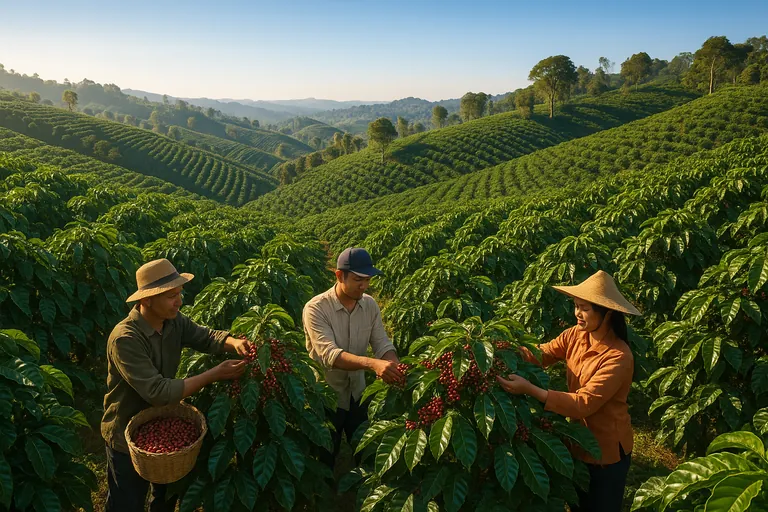
A practical, step-by-step playbook for getting a non-preferential Certificate of Origin (SKA Umum) for Indonesian coffee via the Ministry of Trade’s e‑SKA system in 2025. What to prepare, where to apply, timelines, costs, and how to avoid rejections.
If you export Indonesian coffee, you’ll be asked for a Certificate of Origin at some point. And if you’ve ever had an e‑SKA submission bounced back at 4:58 p.m. on a Friday, you know how costly small mistakes can be. This is the guide we wish everyone had before their first shipment.
We focus on the non-preferential Certificate of Origin, also called SKA Umum, for HS 0901 coffee. This is the version most buyers, banks and forwarders ask for when they say “just send me the COO.”
Who issues the COO and where do I apply?
- System: Indonesia’s Ministry of Trade e‑SKA platform (often accessed via INATRADE). Search “e‑SKA Indonesia login” and you’ll land on the official portal. You’ll need an active NIB to register.
- Issuing offices: Your application is verified and signed by a PPSKA (Pejabat Penerbit SKA) at provincial/city trade offices. In practice, exporters pick a convenient office like Dinas Perdagangan DKI Jakarta (Jakarta), Dinas Perindustrian dan Perdagangan Jawa Barat (Bandung), or Dinas Perindustrian dan Perdagangan Jawa Timur (Surabaya). Choose the office that already knows your company and product. It speeds things up.
In our experience, consistency matters. Use the same issuing office for repeat lanes unless you truly need to switch. Officers get to know your documentation style and origin evidence, which reduces queries.
What documents do I need for SKA Umum (green coffee)?
For HS 0901.11 or 0901.12 green coffee exports, prepare:
- Commercial Invoice and Packing List. Make sure quantity, weight and marks match the PEB exactly.
- PEB (customs export declaration). Use the final version that matches your invoice.
- Bill of Lading or AWB. If you apply pre-shipment, attach the booking or draft BL. Some offices will issue with a booking plus an undertaking to upload final BL.
- Origin evidence. For coffee, this is straightforward but often overlooked.
- Purchase contracts or invoices from Indonesian farmers/coops/collectors showing origin districts and harvest references.
- A brief Process/Origin Statement from your mill or processor confirming beans were grown and processed in Indonesia.
- Company basics. NIB, NPWP and your e‑SKA company profile must be accurate and up to date.
Two practical tips we’ve learned:
- Put the HS code in the description line on your invoice. Officers like to see “HS 0901.11 green arabica coffee beans.” It avoids HS mismatches.
- Use consistent product naming across all docs. If your invoice says “Sumatra Mandheling green arabica,” don’t switch to “Lintong G1” on the PEB.
If you’re shipping single-origin lots like Arabica Bali Kintamani Grade 1 Green Coffee Beans or Blue Batak Green Coffee Beans, origin proof is simpler because the supply chain is clean and local. Keep your farm or coop traceability ready.
Step-by-step: e‑SKA application for coffee in 2025
- Company registration. Log into e‑SKA with your NIB-linked account. Complete your exporter profile, including address, phone, authorized signatory and product HS list.
- Create a new application. Choose “SKA Umum” (non-preferential). Select your issuing office.
- Fill shipment details. Exporter, consignee, transport mode and port, BL/AWB number, PEB number, Incoterms, and final destination.
- Enter goods details. HS 0901, product name, quantity, net/gross weight, number of packages, and marks and numbers. Use the exact terms from your invoice/PEB.
- Upload supporting documents. Invoice, packing list, PEB, BL/AWB or booking, origin evidence. Ensure scans are legible and under size limits.
- Submit and monitor. Officers typically respond within business hours. If they request a correction, resolve it inside the same application. Don’t create duplicate submissions.
- Issuance and download. Once approved, you’ll get a digitally signed COO with a QR code. Many buyers accept the PDF. Print on A4 if they want a hard copy.
Here’s the thing. When you keep your HS description and quantities consistent, approvals often happen same day. Most delays come from tiny mismatches.
How long does it take and how much does it cost in 2025?
- Processing time. Clean applications are issued in 3–24 working hours. If the officer queries origin evidence or HS descriptions, expect 1–2 extra days.
- Costs. The COO itself is usually free of government charges. If you use a forwarder or agent, expect IDR 100,000–300,000 per COO for service. Courier legalization or multiple copies may add small fees.
- Cutoffs. We aim to submit before the vessel ETD and update the BL once available. Many issuing offices can issue post-shipment, but buyers usually want the COO within 3–5 days of BL date. Plan accordingly.
Practical takeaway: bake COO time into your booking milestone. We target “Docs Final” at least 24 hours pre-ETD for ocean and 12 hours for air.
Do I still need a COO for EU or US when the tariff is already 0%?
Short answer. Often yes, because your buyer or bank wants it. Green coffee imports into the EU and US are generally duty free under MFN. A non-preferential COO isn’t needed for duty, but it’s often used as:
- A standard proof of origin for internal audits and traceability.
- A document required by Letters of Credit and bank collections.
- A comfort document for customs brokers in sensitive ports.
If your buyer confirms “no COO needed,” you can skip it. But if the LC stipulates a COO, you must issue SKA Umum in the exact format they require.
Why e‑SKA applications get rejected and how to fix them
Most rejections we see fall into six buckets:
- HS code mismatch. PEB shows 0901.11 but invoice or COO description is vague or shows a different subheading. Fix by aligning HS and using explicit descriptions like “Green Arabica Coffee Beans, HS 0901.11.”
- Quantity/weight inconsistency. Net and gross weights differ across invoice, packing list, and PEB. Fix by aligning net and gross everywhere. If you adjust after stuffing, update the PEB first.
- Consignee or destination mismatch. COO shows a consignee different from invoice/LC. Fix by following the LC first, then mirror that in e‑SKA.
- Missing origin evidence. Especially for roasted coffee or when a new officer reviews your file. Fix by attaching a simple mill letter: “Beans grown and processed in Indonesia,” plus purchase docs from local suppliers.
- Scans unreadable or truncated. Officers won’t guess. Re-scan as clear PDFs and keep file sizes reasonable.
- Wrong issuing office selection. Some offices decline unfamiliar exporters without local ties. Choose an office that already handles your sector.
We also recommend you avoid generic product names like “Coffee beans.” Include origin region. For example, “Sumatra Mandheling green arabica, HS 0901.11” matches our Sumatra Mandheling Green Coffee Beans and passes officer scrutiny faster.
Does roasted or blended coffee still qualify as Indonesian origin?
- Roasted coffee. If the beans are grown in Indonesia and roasted locally, you can get SKA Umum stating Indonesian origin. Officers may ask for upstream purchase docs and a production statement. If you roast imported beans in Indonesia, don’t expect Indonesian origin for SKA Umum. Roasting alone usually doesn’t confer origin for non-preferential rules.
- Blends. Blending Indonesian beans from different islands is fine. A national-origin COO is still valid. We do this for products like our Roasted Espresso Coffee Blend when all components are Indonesian. But if the blend includes any foreign beans, you generally can’t declare the entire lot as Indonesian origin. Segregate lots or declare mixed origins as your buyer instructs.
For green coffee, origin is easiest when lots are single-origin and traceable. If you want variety while keeping origin simple, Indonesian multi-region blends like Bali, Java, Gayo & Mandheling - Wine Green Arabica Coffee Beans remain 100% Indonesian.
HS 0901 origin criteria in practice
Coffee is “wholly obtained” when grown in Indonesia. That’s your strongest origin claim. Processing like hulling, washing, drying, and grading inside Indonesia supports this. For roasted coffee, demonstrate that the underlying green beans were Indonesian and the roasting occurred here. Keep procurement records for 3–5 years. Officers do random checks.
A quick note on REX and FTAs. SKA Umum is non-preferential. EU REX and preferential forms (Form D, AK, AJ, etc.) serve different purposes. For coffee, MFN rates in key markets are already zero, so you rarely need preferential certificates. If a buyer insists, clarify the trade basis first.
Timeline playbook we actually use
- Day 0–1. Confirm HS, consignee, and Incoterms with buyer. Align product description early.
- Day 1–2. Prepare invoice/packing list. Double check weights and marks.
- Day 2–3. Submit e‑SKA with PEB and booking/draft BL. Respond fast to any queries.
- Day 3–4. Upload final BL if required. Download final COO PDF and share with buyer and bank.
This cadence avoids the weekend trap. Three out of five rejections we’ve seen happened when teams rushed COO after the vessel sailed.
2025 updates worth knowing
- Digital acceptance. More buyers accept the e‑SKA PDF with QR. Physical stamping is requested less, but still happens with conservative banks.
- Tighter data matching. Officers increasingly cross-check PEB data automatically. Expect more “please revise PEB first” feedback rather than manual tolerances.
If you’re navigating a tricky first application or a blended profile, and want a second pair of eyes, feel free to Contact us on whatsapp. A 10-minute review can save a day of back-and-forth.
Quick answers to common questions
Where do I apply and who signs it?
Apply in the Ministry of Trade’s e‑SKA system. The COO is issued by a PPSKA officer at your chosen provincial/city trade office.
How long and how much?
3–24 working hours for clean files. Government fee is typically zero. Agent handling runs IDR 100,000–300,000.
Do EU/US shipments still need a COO?
Not for duty on green coffee, but many buyers, banks, and brokers still require non-preferential COO for their processes. Follow your buyer’s written instruction or LC.
Top rejection reasons?
HS mismatch, weight discrepancies, consignee inconsistencies, weak origin evidence, and unreadable scans. Fix by aligning data across invoice, packing list, PEB and COO, and adding a simple origin statement.
Roasted vs green origin?
Roasted coffee qualifies as Indonesian origin only if the beans are Indonesian and roasted locally. Blends remain Indonesian as long as every component is Indonesian.
If you’re planning a 2025 buying program and want to line up documents early, you can also View our products to match SKUs and HS descriptions from day one. It makes the e‑SKA part feel… boring. Which is exactly what you want.