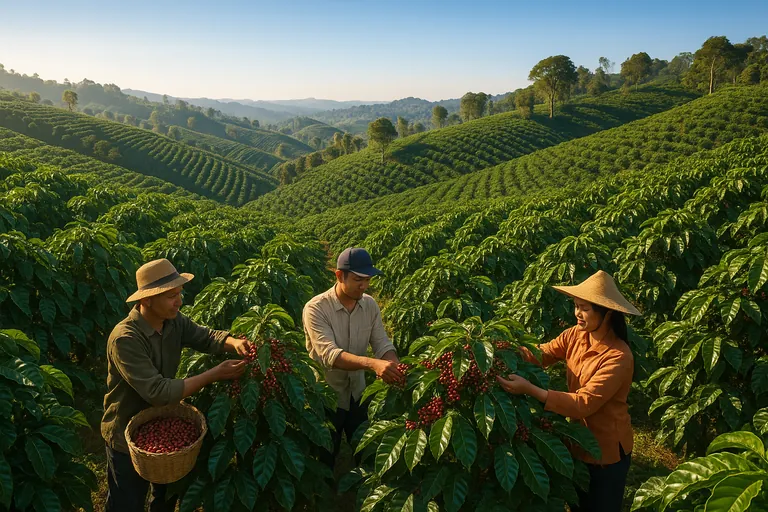
How to evaluate Sumatra Robusta green coffee wholesale in 2026. We cover grades, MOQ, pricing context, harvest timing, export lead times, supplier verification, and what roasters should ask before ordering samples from Indonesia.
If you're evaluating Sumatra Robusta green coffee wholesale in 2026, focus on seven things first. Grade specs, screen size, moisture, defect count, harvest timing, supplier traceability, and export readiness. For most roasters and importers, a reliable buying range is Grade 2 to ELB with screen 15–19, moisture at or below 13%, and clear lot origin from Lampung or North Sumatra. That is the short answer. The rest of this guide shows you how we verify those points on the ground before a container leaves Indonesia.
As the Indonesia-Coffee Team, we source, cup, sort, and export from producing regions across Sumatra. For Robusta, the lots buyers ask us about most often are Lampung for scalable commercial volume and Sidikalang, North Sumatra for buyers who want stronger origin identity and tighter cup performance for espresso blends.
What quality grade should you expect from Sumatra Robusta in 2026?
The practical answer is that most exportable Sumatra Robusta falls into three buying lanes.
Grade 4 to Grade 3 is usually bought for soluble, industrial, and price-sensitive blends. Grade 2 is where many commercial roasters get the best balance of value and roast consistency. ELB 350 / ELB 450 is where buyers typically move when they want larger screen size, more uniform development, and better visual prep for espresso and premium blends.
In our current Robusta program, buyers typically compare three options:
- Sumatra Robusta Green Coffee Beans for general wholesale and blending needs.
- Robusta Lampung Green Coffee Beans (ELB & Grades 2–4) for scalable commercial grades and ELB selections.
- Robusta Sidikalang Green Coffee Beans (Grade 2) for roasters who want North Sumatra identity and stronger blend positioning.
From a cup perspective, clean export Robusta from Sumatra generally lands around 78–82 points depending on grade, prep, and roast intent. Better Sidikalang and carefully prepared Lampung ELB lots can present dark chocolate, cedar, spice, and a heavier crema contribution with lower harshness than buyers expect from commodity-style Robusta.
Here's what this means for your roastery. If you sell milk-based espresso, dark roast retail, or need body and crema in a blend, paying a bit more for Grade 2 or ELB usually reduces roast variability and lowers sorting losses.
How do we assess lots at farm and mill level?
This is where a direct Sumatra Robusta coffee supplier should be able to speak concretely.
For Lampung, we usually work with smallholder networks in West Lampung and Tanggamus, mostly between 600–900 masl. Cherries are commonly natural-dried, then hulled and sorted at collector and warehouse level. For Sidikalang, Dairi Regency lots generally come from 900–1,200 masl, which is relatively high for Robusta and one reason some lots cup cleaner and sweeter than lowland material.
Before we offer a lot, we check moisture, screen distribution, odor, visible mold risk, and defect patterns. We also roast sample batches because two lots with similar green appearance can behave very differently in first crack and smoke output.
What most buyers overlook is the drying risk. During wetter periods, Robusta can look acceptable but hide instability if drying wasn't completed evenly. That is why we prefer lots that stabilize at 12–13% moisture and rest before shipment.
If you want to compare current specs side by side, View our products.
How can you verify the authenticity of a Sumatra Robusta coffee supplier?
This is one of the smartest questions a buyer can ask.
A real Sumatra coffee supplier Indonesia should be able to provide more than a nice catalog. Ask for these five things.
1. Can they name the producing area clearly?
"Sumatra" is too broad on its own. We expect buyers to ask whether the lot is from Lampung, Sidikalang, or another producing pocket, and whether it comes through a cooperative, village collectors, or a private mill.
2. Can they explain processing and prep?
For example, our Sumatra Robusta lots are typically natural sun-dried, then machine-cleaned and hand-sorted depending on target grade. If a supplier can't explain drying method, storage conditions, and final moisture target, that's a red flag.
3. Can they share current crop timing?
For southern Sumatra, the main Robusta harvest typically runs May to September, with some local variation. If a supplier offers large fresh volume off-season without explanation, ask more questions.
4. Can they provide lot documentation?
Serious exporters should be ready with packing list format, phytosanitary support, certificate of origin support, fumigation coordination where required, and moisture/grade specs per lot.
5. Will they send representative samples?
If a supplier resists sending a production sample, don't move to a large contract.
Buyers who want to taste before committing can Contact us on whatsapp and ask for current-crop sample availability.
What is the minimum order quantity for wholesale Sumatra Robusta?
The honest answer is that MOQ depends on whether you are buying as a roaster, trader, or container buyer.
For export, a practical MOQ for many suppliers starts at 1 full bag sample order, then 10–20 bags for trial commercial volume, and 1 x 20 ft container for the most efficient freight economics. Standard bag weight is usually 60 kg or 69 kg depending on packing requirement and destination preference.
For our side, we usually guide buyers like this:
- Sample stage. 300 g to 2 kg roasted or green reference sample.
- Trial stage. 5 to 20 bags for cupping validation and first roast production.
- Scale stage. Consolidated LCL or FCL depending destination and mix.
If you're a specialty roaster asking about minimum order quantity for Sumatra Robusta coffee, don't assume container-only. The right supplier should help you test first, then scale once your roast profile and blend economics are confirmed.
How do Sumatra Robusta wholesale prices vary in 2026?
For Sumatra Robusta wholesale price per kg 2026, think in ranges, not one fixed number. Prices move with ICE London Robusta futures, rupiah exchange rate, inland trucking, port congestion, and prep level.
In practical terms, buyers can expect these variables to move price up or down:
- Grade. ELB and cleaner Grade 2 lots command a premium over Grade 3–4.
- Origin specificity. Sidikalang or traceable village lots often price higher than generic blended bulk.
- Screen size and sorting. Uniform screen 15–19 with lower triage loss costs more.
- Certifications and compliance. Organic, verified documentation, or buyer-specific testing adds cost.
- Shipment size. Small LCL shipments almost always have a higher landed cost per kg than container volumes.
As a supplier, we tell buyers not to compare FOB offers without checking prep standard. A cheaper offer with higher moisture or wider defect tolerance often becomes more expensive after shrinkage, sorting, and roast inconsistency.
From a sourcing perspective, if your use case is espresso blending, paying more for better prep usually protects margin better than chasing the lowest FOB.
What certifications and export documents should you ask for?
The right certifications depend on your market, not just the coffee.
For standard Sumatra Robusta export, buyers commonly ask us about:
- Phytosanitary certificate.
- Certificate of origin.
- Fumigation support where destination requires it.
- Moisture and grade specification sheet.
- Commercial invoice and packing list.
- Organic documentation if the lot is certified organic.
Some buyers also need residue testing, food safety declarations, or importer-specific compliance paperwork. We recommend confirming this before contract, not after the coffee is milled.
If your business also buys Indonesian Arabica, this is where it helps to consolidate sourcing with one exporter who already manages multiple origins and prep styles. For example, some buyers pair Robusta with body-driven Sumatra Arabica such as Sumatra Mandheling Green Coffee Beans or use cleaner citrus-driven origins like Arabica Bali Kintamani Grade 1 Green Coffee Beans for blend top notes.
Can you request samples before buying wholesale Sumatra Robusta?
Yes, and you should.
A sample request is the fastest way to verify whether you should order Sumatra Robusta beans at all. We recommend asking for two things. A pre-shipment green sample from the exact grade you intend to buy, and the lot spec sheet showing origin, moisture, screen size, and defects.
When we prepare samples for roasters, we prefer to include brief roasting guidance because Robusta can flatten or turn ashy if treated exactly like washed Arabica. For espresso use, many buyers get better results by extending development carefully rather than pushing only for color.
If you want a production-matched sample and current lot sheet, Contact us on email.
What lead times should you expect for Sumatra Robusta coffee orders?
For lead times for Sumatra Robusta coffee orders, a realistic planning range is:
- Samples. Usually 3–7 working days to prepare, plus courier transit.
- Spot lots ready in warehouse. Around 7–14 working days for prep and export documentation after confirmation.
- Fresh milling or custom prep. Often 2–4 weeks depending on grade target and volume.
- Ocean transit. Varies by destination, but many buyers plan 3–6 weeks after vessel departure.
If you are importing to the USA, Europe, or the Middle East for the first time, build in extra time for documentation review and destination customs coordination. The coffee is rarely the only lead-time variable. Booking, paperwork, and destination handling often create the real bottleneck.
How does Sumatra Robusta compare with Indonesian Arabica for wholesale buyers?
If you're deciding between Robusta and Arabica, the answer comes down to use case.
Choose Sumatra Robusta when you need body, crema, lower blend cost, and dark chocolate-earthy depth. Choose Indonesian Arabica when you need more aromatic complexity, higher acidity structure, or a single-origin specialty offer.
Many of our buyers don't choose one or the other. They build around both. A common approach is a 10–30% Robusta component in espresso, then balancing sweetness or acidity with Arabica from Mandheling, Java, or Bali.
Final buying advice for 2026
If you are looking for where to buy Sumatra Robusta green coffee wholesale, don't start with price alone. Start with lot honesty. Origin clarity, moisture discipline, grade consistency, and sample transparency will tell you more about your eventual landed value than a low opening quote ever will.
Our recommendation is simple. Cup two or three lots side by side. Compare a scalable Lampung grade with a more identity-driven Sidikalang lot. Check screen size, roast loss, crema performance, and defect tolerance against your actual blend target. Then scale from sample to trial volume.
That is the lowest-risk way to buy well in 2026, and it is how we help new buyers move from interest to confident first orders.